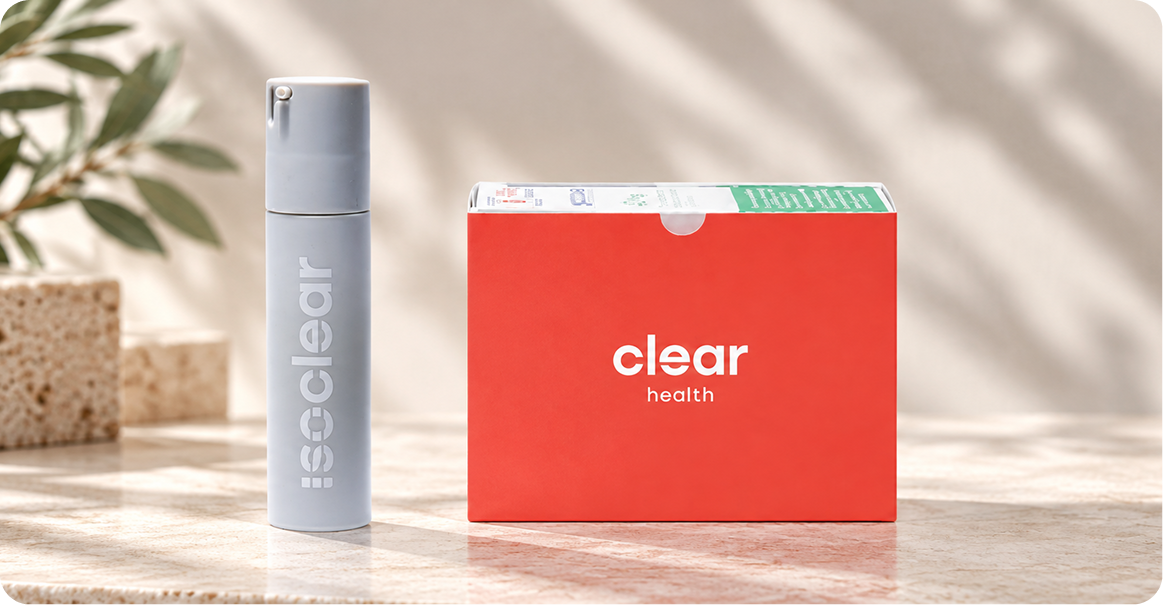
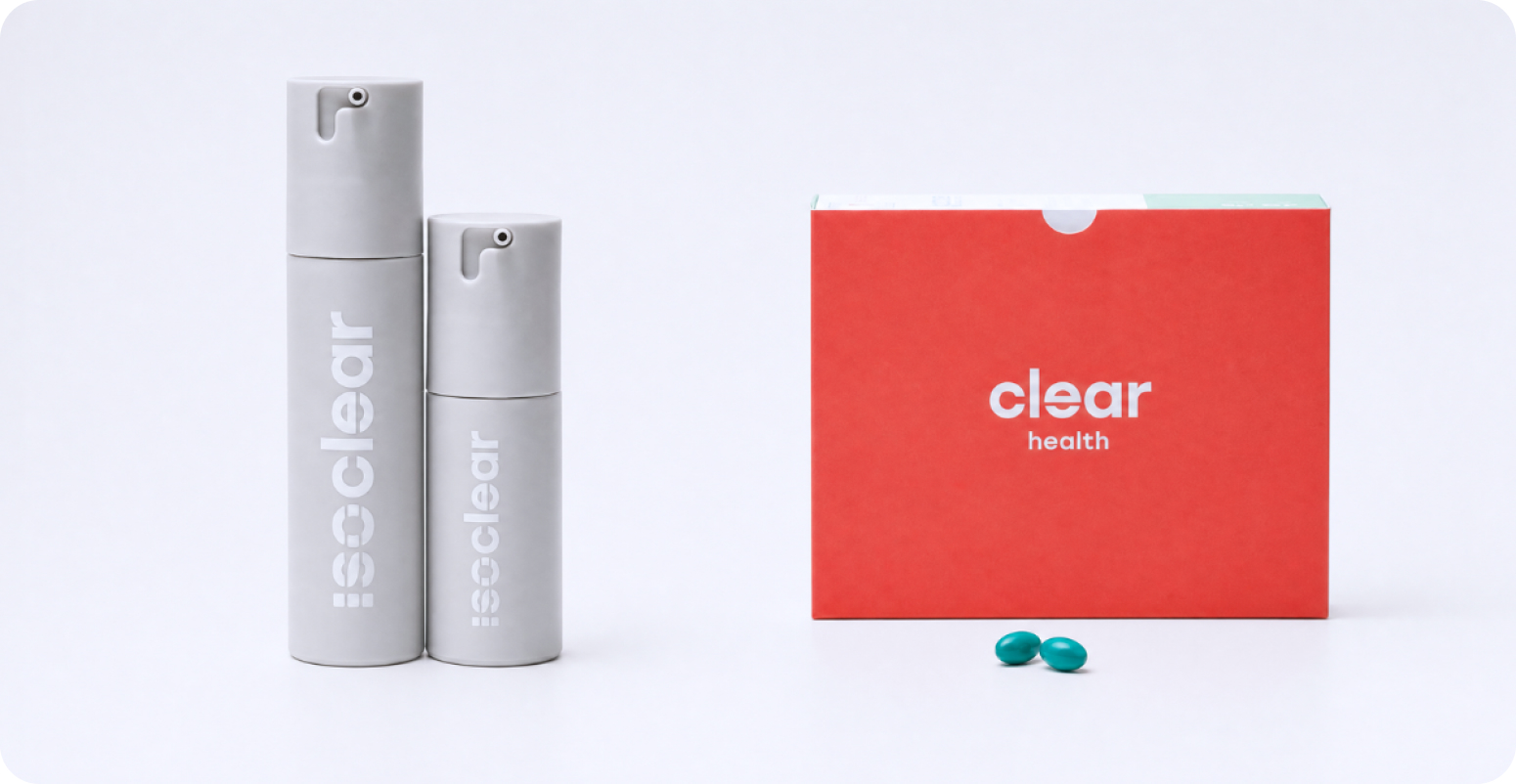
At Clear Health, we’re all about being upfront about our offerings whether it’s a prescription medication or a skincare product. We’ve put together a breakdown of everything so you know exactly what you’re getting when you order from us.
KEY TERMS:
Non-Comedogenic: Won’t clog pores and subsequently cause breakouts
SLS: Sodium Lauryl Sulfate/Sodium Laureth Sulfate. Popular ingredients often used as a foaming agent in cheap cleansers, and can also be used as an emulsifier (to bind ingredients together) in rich lotions. SLS can be irritating to skin.
Parabens: Preservative ingredients that are banned in the EU and have been linked to toxicity in some lab tests [1]
Prescription Customized Cream
The customized cream may contain a blend of four main active ingredients that are specifically chosen for their efficacy in treating moderate forms of acne: Tretinoin, Clindamycin, Azelaic Acid, and Niacinamide, all in a super gentle Vitamin E and silicone base.
PRO TIP: We ALWAYS recommend testing your skin’s sensitivity to your prescribed customized cream by applying only every other night, and potentially diluting it in with a moisturizer before beginning daily use.
Tretinoin
Like Isotretinoin (Accutane), Tretinoin is derivative form of Vitamin A but in topical form. Known as the gold-standard for topical prescription acne treatments, Tretinoin can help regulate sebum production while also having anti-inflammatory properties and can also improve fine lines and wrinkles. Lower strengths common in other platforms tend to be used for anti-aging purposes, while we offer higher strengths (up to .09%) which have been shown to be more effective for acne.
Clindamycin
Clindamycin is a prescription grade antibiotic that targets acne bacteria on the skin, while also combatting the inflammation that comes with acne. We combine Clindamycin with Tretinoin together, which has been shown to be more effective on treating acne than Clindamycin on its own. [2]
Azelaic Acid
For women who are pregnant or trying to conceive, we include Azelaic Acid in our customized cream prescriptions as an alternative to Tretinoin – although topical Tretinoin use is not directly linked to birth defects in a baby of a pregnant woman, we err on the side of caution and do not prescribe it for those populations.
Azelaic Acid is a naturally occurring acid in grains such as barley, wheat, and rye, and has antimicrobial and anti-inflammatory properties that can produce similar results as Tretinoin. We also use Azelaic Acid in our Post-Accutane treatment creams as it does not cause antibiotic resistance over sustained, long-term use.
Niacinamide
Vitamin B3 with anti-inflammatory properties, Niacinamide helps to calm the redness that’s associated with acne while also inhibiting the production of oil that leads to clogged pores. Niacinamide is also non-irritating, making it suitable for sensitive or dry skin types.
BASE Formula
The base we use for our customized creams includes Vitamin E and silicones and is free of SLS, parabens, dyes, fragrances, mineral oils, or preservatives. It has an elegant feel when applied to skin, and can help the skin’s healing process as it is intended for damaged or scarred skin (which includes acneic skin).
Nefaire Skincare
Nefaire is our esthetician-designed line of premium essentials that were developed in tandem with our dermatologists. Acne is usually a trigger for people to start taking their skincare seriously, and we felt that the standard products you find in drugstores had some seriously outdated formulations, while more premium brands were charging way too much. Nefaire is minimalist by design, and we’ve built our products to perfectly complement prescription acne regimens, or be used on their own.
Jojoba Oil Cleanser
We counterintuitively designed an oil cleanser for acne-prone skin, using Jojoba oil as a base. Jojoba oil mimics the sebum on human skin, is non-comedogenic, and can actually help with acne. [3] It’s important to remember that even with oily, acne-prone skin, having adequate moisture is key to preventing further breakouts (if your skin is dehydrated, it will produce more oil to overcompensate), which is why the foaming cleansers you find in drugstores can be doing more harm than good in many cases as they strip the skin of its natural moisture.
We combined Jojoba with Sunflower Seed oil, which is packed with Vitamin E and Linoleic Acid that helps the skin maintain its natural protective barrier, along with Caprylic/Capric Triglyceride which are non-comedogenic fatty acids that bring moisture to your skin.
Lightweight Moisturizer
Our moisturizer contains powerful, hydrating ingredients including Hyaluronic acid, which is a gold standard ingredient for helping the skin retain water. We’ve also added Licorice Root Extract which can help even out skin tone, as well as Panthenol which comes from Vitamin B5 and has anti-inflammatory properties. Specifically formulated to feel non-greasy on the skin, our moisturizer is a perfect complement to our Jojoba oil cleanser to bring balance to acne-prone skin.
- Petric Z, Ružić J, Žuntar I. The controversies of parabens - an overview nowadays. Acta Pharm. 2021 Mar 1;71(1):17-32. doi: 10.2478/acph-2021-0001. PMID: 32697748.
- Schmidt N, Gans EH. Clindamycin 1.2% Tretinoin 0.025% Gel versus Clindamycin Gel Treatment in Acne Patients: A Focus on Fitzpatrick Skin Types. J Clin Aesthet Dermatol. 2011;4(6):31-40.
- Gad HA, Roberts A, Hamzi SH, et al. Jojoba Oil: An Updated Comprehensive Review on Chemistry, Pharmaceutical Uses, and Toxicity. Polymers (Basel). 2021;13(11):1711. Published 2021 May 24. doi:10.3390/polym13111711



-1771011484-073804.jpg)